
Commercial Solar Solutions in Malaysia for 2026
Cut your company’s electricity spending by 30–50%. Choose a cash purchase, business financing, or a zero-upfront PPA. Eligible companies may also claim the 60% GITA tax allowance. We provide a free remote solar review for factories, warehouses, hotels, shops, offices, and other commercial properties.
Submit the project brief
Share the facility, bill, and required outcome. We review commercial requests during business hours.
- Custom system design for your business
- ROI analysis based on your electricity usage
- Flexible financing: PPA, hire purchase, or bank loans
- Solar ATAP, TNB and application support
Why install solar at your business?
Turn unused roof space into lower operating costs, cleaner energy, and long-term value.
Reduce energy costs by 40–70%
Use daytime solar power to lower the amount of electricity bought from the grid.
Built for 25 years of output
Receive long-term performance protection and full product warranty support.
Strengthen your ESG results
Lower carbon emissions and show customers, investors, and partners that your company takes sustainability seriously.
Use available tax benefits
Qualified companies can reduce the real cost of a solar investment through Malaysia’s green technology tax incentives.
Information needed for a useful first assessment
The first review uses verified site inputs. Final size, savings, and equipment depend on the bill, operating hours, and available roof or land.
- Recent complete electricity bill and tariff category
- Operating hours, occupancy and major daytime loads
- Roof, car park or land type and approximate area
- Ownership or tenancy information
- Required outcome, commercial model and decision timeline
A solar plan for every type of business
Every site uses power differently. We design each system around the building, roof, operating hours, and electricity demand.
Manufacturing plants
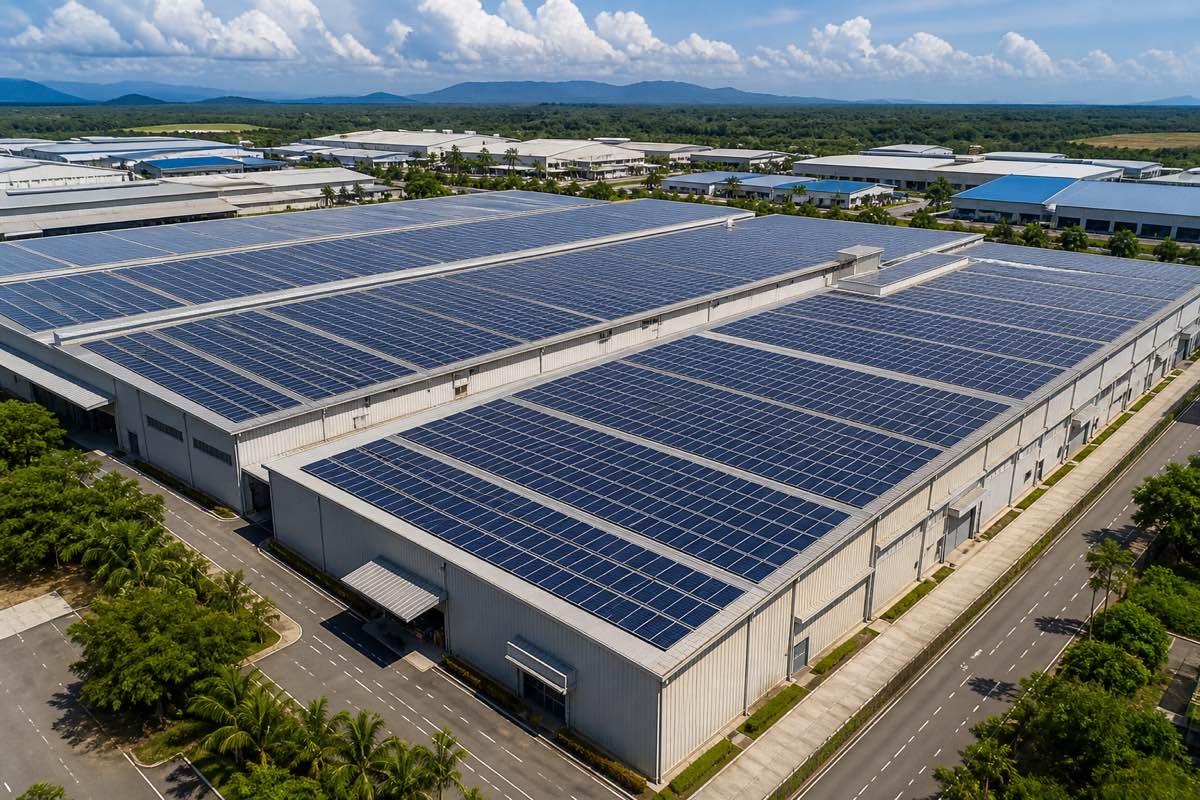
Large solar systems for factories, workshops, and production lines with high daytime use.
RM 15,000–50,000 / month typical savingsRetail and commercial properties
Purpose-built systems for malls, stores, mixed-use buildings, and offices.
RM 5,000–20,000 / month typical savingsWarehouses and distribution hubs
High-output rooftop systems that make good use of wide, open roof areas.
RM 10,000–30,000 / month typical savingsCorporate offices
Integrated solar systems for headquarters, business parks, and office blocks.
RM 8,000–25,000 / month typical savingsCommercial solar sizes and estimated prices
The estimates below cover panels, inverter, mounting, electrical cabling, TNB application work, testing, and commissioning.
Small Business
- SME offices, clinics, cafés, and restaurants
- TNB bills of RM 2,000–8,000 per month
- Estimated savings RM 1,500–5,000 / month
- Payback about 4–6 years
Medium Commercial
- Factories, warehouses, hotels, and schools
- TNB bills of RM 8,000–30,000 per month
- Estimated savings RM 5,000–18,000 / month
- Payback about 3–5 years
Large Commercial
- Large plants, malls, campuses, and data centres
- TNB bills of RM 30,000–200,000 per month
- Estimated savings RM 18,000–50,000 / month
- Payback about 2.5–4 years when GITA applies
Commercial solar for different industries
We match the system design to the daily energy pattern, operating hours, roof condition, and priorities of each sector.
Ways to finance commercial solar
Choose a funding method that fits your cash flow, ownership goals, and tax position.
Green bank financing
3.5–5.0%Maybank, CIMB, and Public Bank provide green financing with terms of up to 10 years. This route suits companies that want to own the system and use GITA.
PPA with no upfront cost
RM 0We fund, install, and own the equipment. Your company pays only for the solar electricity it uses, usually 15–30% below the TNB rate.
GITA tax allowance
60%Claim a 60% Green Investment Tax Allowance on eligible capital spending. The stated deadline is 31 December 2026.
How a commercial project moves forward
We use a clear five-stage process from the first review to the final handover.
Energy review
Bills, operating schedule, load pattern, and future power needs.
Tailored proposal
Layout, production, savings, payback, and financing choices.
Permits
Regulatory papers and the relevant TNB submissions.
Installation
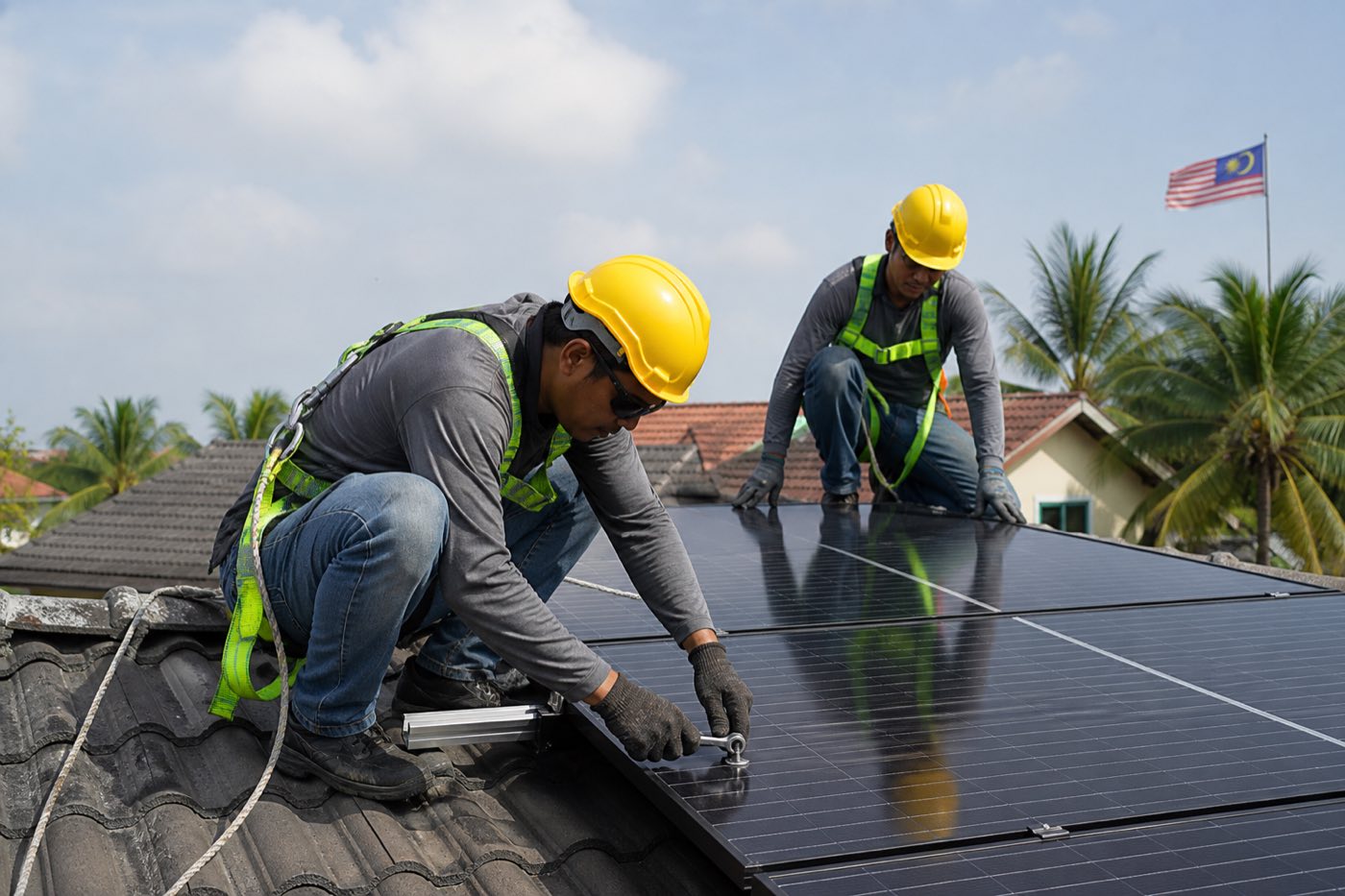
Trained installers plan around your normal operations.
Handover
Testing, grid connection, and a clear operating briefing.
For many Malaysian companies, solar can deliver a strong return because commercial electricity use is high during daylight hours. The stated TNB C1 commercial energy rate is 43.60 sen per kWh for low-voltage customers. The stated C2 rate is 38.00 sen per kWh for medium-voltage users.
Some industrial customers also pay maximum-demand charges. The stated rates range from RM 30.30 per kW for C1 low voltage to RM 89.27 per kW for the E2 medium-voltage peak/off-peak category.
Solar can reduce daytime grid demand. When paired with commercial battery storage and peak-shaving controls, it may reduce the maximum-demand part of the bill by 20–40%.
In Malaysia, a well-designed 100 kWp rooftop system may generate about 120,000–140,000 kWh each year. At the stated C1 rate, that output may be worth roughly RM 52,000–61,000 in annual savings.
A fully installed system may cost RM 350,000–450,000. This gives an estimated payback of 4–6 years before GITA. For a qualifying company, the stated payback may fall to about 2.5–4 years after the 60% Green Investment Tax Allowance is applied.
TNB Business Tariffs and Solar Savings in 2026
The tariff shown on your TNB account affects the value of every unit of solar power you use. Check the account category before choosing the system size.
- C1, Low-Voltage Commercial: The stated rate is 43.60 sen per kWh. It commonly covers offices, restaurants, shops, clinics, and smaller factories with demand below 1 MW.
- C2, Medium-Voltage Commercial: The stated rate is 38.00 sen per kWh. It generally applies to larger commercial or industrial buildings above 1 MW.
- E1 and E2, Industrial: These tariffs include maximum-demand charges. The stated monthly charge runs from RM 45.10 per kW for E1 general medium voltage to RM 89.27 per kW for E2 medium-voltage peak/off-peak use. Solar with battery storage can directly target part of this cost.
Solar panels usually deliver most of their output between 8 a.m. and 5 p.m. Many businesses also use the most power during these hours. That overlap allows the company to consume its own solar energy instead of buying the same amount from TNB.
Under the stated Solar ATAP arrangement, effective from January 2026, the grid buys exported excess power at the System Marginal Price. Self-used energy normally creates more value because it replaces electricity charged at the full retail tariff.
A good design therefore follows the site’s daytime load rather than filling every available part of the roof without checking demand.
GITA 60% Green Investment Tax Allowance: Stated Deadline: December 2026
GITA can improve the financial return for a Malaysian company that invests in eligible solar equipment. The scheme allows a company to claim 60% of qualifying capital expenditure as an allowance against statutory income for three years.
Take a RM 500,000 project as an example. At a 24% corporate tax rate, the stated GITA benefit is about RM 72,000. That would bring the effective project cost down to around RM 428,000 and may shorten the recovery period by one or two years.
The stated application deadline is 31 December 2026. Applications go through MGTC. We can prepare the application as part of the project. This includes MyHIJAU equipment records and the figures needed for the MIDA statutory-income calculation.
Funding a Commercial Solar Project in Malaysia
Businesses can normally choose from four main payment routes:
- Green business loans: Maybank, CIMB, Public Bank, and RHB offer stated rates of 3.5–5.0% a year with terms of up to 10 years. This is useful when the company wants ownership and plans to claim GITA.
- Power Purchase Agreement: The provider pays for and owns the system. Your business buys the solar electricity it uses at a rate stated to be 15–30% below TNB. There is no upfront equipment cost.
- Hire purchase: Pay a fixed amount each month for five to seven years. Ownership passes to the company at the end of the term.
- Cash purchase with GITA: This may deliver the highest long-term return when the company has available cash and enough taxable income to use the allowance.
Get a Free Remote Solar Review for Your Business
A remote assessment takes only a few minutes to start. Open the commercial ROI calculator and enter the latest TNB bill details. We will estimate a suitable system size, likely electricity savings, payback time, and available funding routes.
If the design needs measurements at the property, you can book a priority site visit for RM 100. We credit the full visit fee toward the project when you proceed.
What Makes Us Different
We give Malaysian businesses a faster and clearer route from the first electricity-bill review to a working commercial solar system.
Proposal Ready in About 60 Seconds
Upload your TNB bill. Our digital system reviews it and prepares an early proposal with system capacity, estimated return, and possible payment plans.
One Digital Place for the Whole Project
Follow each stage online, from quotation and documents to installation and commissioning. View progress updates, sign forms, and contact the team without chasing paperwork.
Solar ATAP and TNB Paperwork
We prepares the Solar ATAP, TNB, and grid-connection documents needed for review, export, and compliance.
Founded by MIT Alumni
The company was started by MIT-trained engineers with experience in energy systems, commercial project economics, and grid connection.
Frequently Asked Questions
How much does a commercial solar installation cost in Malaysia?
A small 10–30 kWp project is estimated at RM 35,000–120,000 and may suit an office, clinic, restaurant, or other SME. A 30–100 kWp system is estimated at RM 120,000–400,000 and may suit a factory, hotel, school, or warehouse.
A larger 100–500 kWp installation is estimated at RM 400,000–1,800,000. These prices cover the main equipment, inverter, mounting structure, wiring, TNB application, system tests, and commissioning. Eligible businesses may lower the effective cost through the 60% GITA allowance.
How quickly can commercial solar pay for itself?
The stated payback period is usually three to five years. A 100 kWp system may save roughly RM 8,000–10,000 each month at the stated C1 tariff of 43.60 sen per kWh.
Over 25 years, the projected saving is RM 2.4 million against an installed cost of around RM 350,000–450,000. A qualifying GITA claim may shorten the estimated payback to 2.5–4 years.
Is my company allowed to claim GITA for a solar project?
Eligible Malaysian companies that buy qualifying solar equipment may claim the Green Investment Tax Allowance. The allowance equals 60% of qualifying capital expenditure and is used against statutory business income.
On a RM 500,000 installation, the stated corporate tax saving is about RM 72,000. The stated deadline is 31 December 2026. We can prepare the MGTC forms, MyHIJAU records, and related supporting documents.
What system capacity will my property need?
The right size depends on the monthly bill, tariff, daytime demand, operating schedule, and usable roof area.
As a starting guide:
- A property paying RM 3,000–8,000 per month may need 10–30 kWp.
- A bill of RM 8,000–30,000 may point to 30–100 kWp.
- A bill of RM 30,000–200,000 may require 100–500 kWp.
Our remote review uses the TNB bill and available roof images to estimate a suitable size under the stated Solar ATAP rules.
Can a Malaysian commercial property use a PPA?
Yes. Under our stated PPA model, we pay for, install, and own the solar equipment. The customer pays only for the solar electricity used, at a price stated to be 15–30% lower than TNB. No initial capital payment is needed.
Agreements normally last 10–20 years and may include an option to transfer ownership when the term ends.
Which TNB tariff determines commercial solar savings?
Many commercial properties use C1, with a stated rate of 43.60 sen per kWh, or C2, with a stated rate of 38.00 sen per kWh.
Under the stated Solar ATAP framework, solar used at the property replaces electricity that would have been bought at the applicable retail rate. This may reduce total bills by 30–50%.
Industrial customers on E1 or E2 may also lower maximum-demand costs by an estimated 20–40% when solar is combined with correctly sized battery storage.
Get a clear solar quote
Packages, Solar ATAP paperwork, and installation support — shown online before you decide.